
Criteria & Principles
Information about antibiotic use in patients with antibiotic allergies can be found in the American Academy of Allergy, Asthma, and Immunology (AAAAI) and the American College of Allergy, Asthma, and Immunology (ACAAI) 2022 update Drug Allergy Practice Parameter.
Incidence of Penicillin Reactions:
|
Types of Pencillin Reactions:
Immediate (Type I IgE-mediated) - anaphylaxis, hypotension, laryngeal edema, wheezing, angioedema, urticaria
|
Late (Type II-IV/delayed IgG or T Lymphocyte-mediated) - rash (e.g., maculopapular, morbilliform, or contact dermatitis); SJS/TEN; destruction of RBC, WBC, or platelets (e.g., hemolytic anemia, thrombocytopenia); serum sickness
|
|
Stevens-Johnson Syndrome - exfoliative dermatitis with mucous membrane involvement
|
Approach to the patient with reported penicillin allergy: Refer to the DUH Raleigh Penicillin Allergy Assessment Guideline or contact the Antimicrobial Stewardship Team for guidance at 919-485-1736.
Diagnosis-Specific Information
Penicillin Cross-reactivity Table:
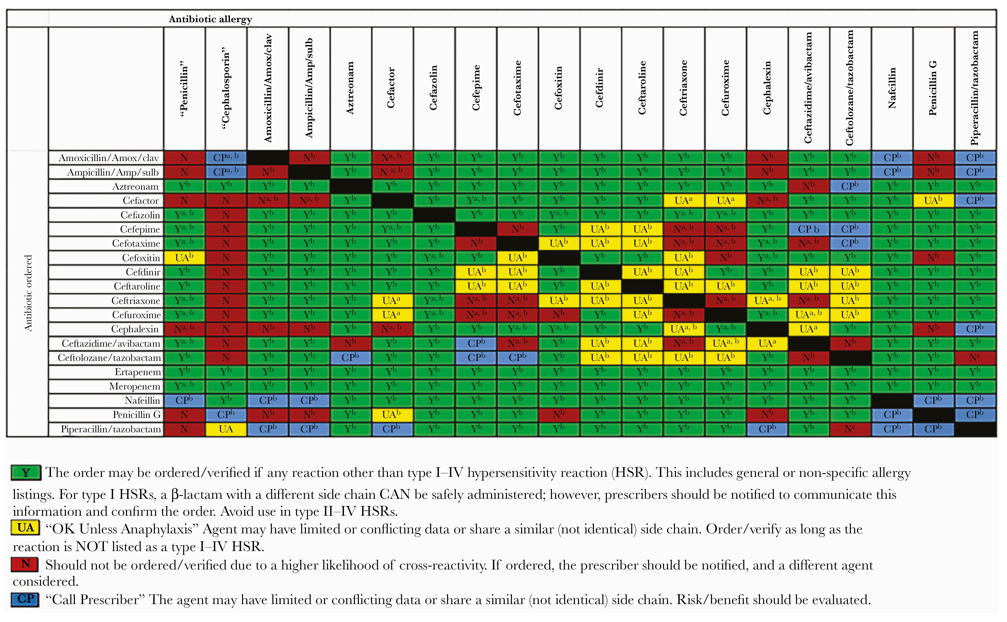
Chart reference: Collins CD., et al. OFID. 2022;9(1)

References
1. Blanca M, Romano A, Torres MJ, et al. Update on the evaluation of hypersensitivity reactions to betalactams. Allergy 2009;64:183-93.
2. Macy E, Contreras R. Health care use and serious infection prevalence associated with penicillin "allergy" in hospitalized patients: A cohort study. The Journal of allergy and clinical immunology 2014;133:790-6.
3. Salkind AR, Cuddy PG, Foxworth JW. The rational clinical examination. Is this patient allergic to penicillin? An evidence-based analysis of the likelihood of penicillin allergy. JAMA 2001;285:2498-505.
4. Charneski L, Deshpande G, Smith SW. Impact of an antimicrobial allergy label in the medical record on clinical outcomes in hospitalized patients. Pharmacotherapy 2011;31:742-7.
5. Sastre J, Manso L, Sanchez-Garcia S, Fernandez-Nieto M. Medical and economic impact of misdiagnosis of drug hypersensitivity in hospitalized patients. The Journal of allergy and clinical immunology 2012;129:566-7.
6. Trubiano J, Phillips E. Antimicrobial stewardship's new weapon? A review of antibiotic allergy and pathways to 'de-labeling'. Current opinion in infectious diseases 2013;26:526-37.